Cost-benefit analysis: building AI workflow software in-house versus outsourcing
The promise of AI-driven workflow optimisation is compelling: automated decision-making, less operational friction, and measurable productivity gains. The harder question is not whether you should pursue it, but how you should build it.
For mid-market companies in the Netherlands and Europe, the choice often becomes binary: build an internal team or hire an external partner. Both paths bring real costs, hidden risks, and organisational consequences that rarely appear in spreadsheet comparisons.
The true cost of building in-house
The visible costs are clear: salaries, benefits, tooling licences, and cloud infrastructure. For a modest AI workflow team — say, two machine-learning engineers, a data engineer, and a part-time architect — a Dutch company may spend €400,000–€600,000 per year before recruitment, onboarding, or inevitable attrition.
But the hidden costs matter more.
Time-to-capability often means waiting 12–18 months before an internal team delivers production-ready AI systems. That is not incompetence. It is the reality of hiring people, establishing development practices, learning your specific domain, and navigating inevitable false starts. During that period, competitors may already be improving their operations.
Opportunity costs accumulate quietly. Your best internal talent is pulled into AI initiatives, creating gaps elsewhere. Technical leadership spends cycles managing a new discipline instead of strengthening existing core capabilities.
Retention risk is especially acute in AI. The Netherlands has a serious shortage of experienced machine-learning practitioners. Expect a carefully assembled team to receive aggressive counteroffers within 18 months. Each departure resets part of your knowledge base.
The benefit is real ownership. Your team develops deep domain knowledge. You have full control over the roadmap. There is no vendor dependency. For organisations that want AI to become a meaningful competitive differentiator rather than only an operational improvement, this is significant.
The real calculus of outsourcing
External development looks simpler on paper: fixed price, defined scope, and transferred risk. Reality is less tidy.
Quality differences are substantial. The market contains excellent specialist companies and mediocre body shops with similar price tags. Telling them apart requires technical judgement — the very capability you may be outsourcing because you do not have it internally.
Coordination overhead is non-linear. Every requirements change, newly discovered edge case, and integration problem requires communication across an organisational boundary. In AI projects, where requirements often emerge through experimentation rather than specification, this friction grows further.
Knowledge extraction is always incomplete. Even with thorough documentation, external teams take implicit knowledge with them when a project ends. You are left with systems whose deepest assumptions live in someone else’s institutional memory.
Outsourcing still has convincing benefits. Experienced partners can improve speed-to-market. You get specialist expertise without a permanent commitment. Cash flow stays more predictable. For AI initiatives that are strategic experiments rather than core investments, this flexibility is valuable.
The hidden third path: hybrid models
Binary thinking hides a spectrum of approaches. Consider these alternatives:
Staff augmentation with internal leadership: bring in specialists while retaining internal architectural control and knowledge retention. You pay higher rates but keep strategic ownership.
Joint-development partnerships: engage an external company as a collaborator rather than a contractor. Shared codebases, pair programming, and explicit knowledge transfer cost more than pure outsourcing but build internal capability.
Productised AI solutions with custom integration: instead of building from scratch, select proven AI platforms and focus internal and external capacity on integration and domain adaptation. The ceiling may be lower, but delivery is faster and risk is reduced.
A decision framework: when each approach makes sense
Lean towards in-house when:
- AI workflow optimisation is part of your core competitive differentiation.
- You have more than 24 months before competitive pressure requires results.
- Existing technical leadership can credibly oversee AI development.
- You are prepared for a multi-year capacity investment.
Lean towards outsourcing when:
- The initiative is strategic but not essential to your competitive position.
- Speed matters more than perfect control.
- Internal technical capacity is already under pressure.
- The scope is well-defined and relatively bounded.
Lean towards hybrid when:
- You want to build internal capacity while delivering results in the short term.
- The domain is complex enough to require deep internal knowledge.
- Internal leadership has enough bandwidth to manage a partnership.
The European context matters
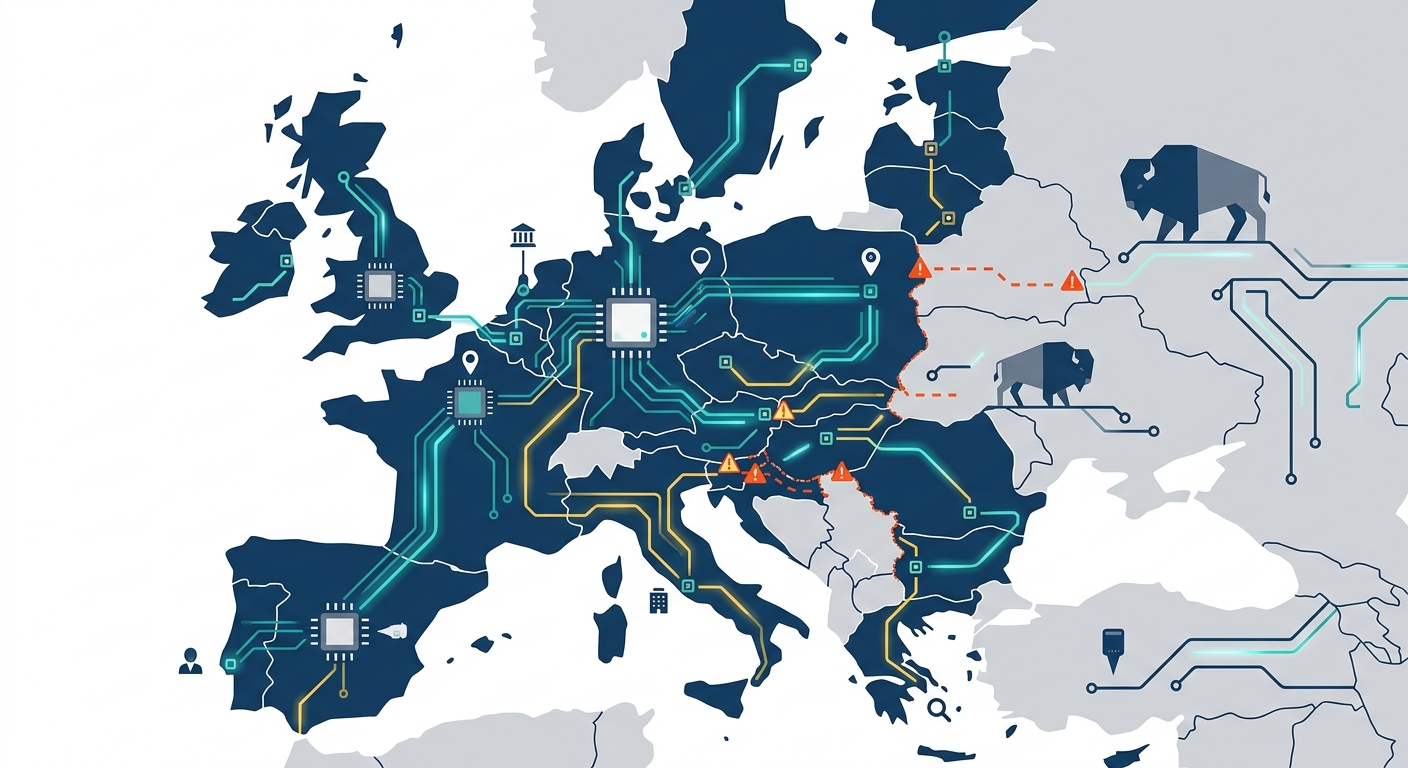
GDPR, AI Act compliance, and data-residency requirements add complexity. Partners based in Europe understand these constraints intuitively. Offshore cost arbitrage often disappears when compliance advice and architecture changes are included.
European employment protections also affect both paths. Internal teams are harder to reduce if initiatives fail. Contractor relationships need to be structured carefully to avoid classification issues.
Make the decision concrete
Spreadsheet analyses fail because they treat this as purely financial. The better questions are organisational:
Do you have internal leaders who understand AI well enough to evaluate external partners or guide an internal team? Can you retain AI talent in your market and at your scale? Is this initiative important enough to justify a permanent capacity investment?
There is no universally correct answer. There is only the answer that fits your specific constraints, timeline, and strategic intent.
Navigating these trade-offs is rarely simple. When you need to choose between building and buying for AI workflow initiatives, Bizonbyte works with European companies to clarify the options and execute pragmatically — whether that means building alongside your team or objectively evaluating external partnerships.
When in-house software costs more, but outsourcing feels like selling your soul.